Wednesday, 7 September 2011

Week 6 - Tutorial Task

Video Update
I'm excited about this task, and finding it slightly daunting. You really have to put a leash on your mind, because when ideas run rampant it is hard to stay focused and realistic. At first we were talking about online dating, and how we could follow people through their experiences of chatting to potential partners online and eventually meeting them in person. This would free us to explore the dangers and also the benefits that could stem from these interactions. Our other idea was a cheesy horror clip about new communication technology attacking their users. Once we finished describing our two ideas to Lauren, she helped narrow our focus down, saying it was impossible to squeeze in everything we wanted into 3 minutes, and the second idea was more achievable. So in the end we decided to make a cheesy horror film trailer about new communication technology attacking their users.


Warned against the dangers of defamation and copyright infringement, we set about brainstorming the best way to go about things. We delegated tasks to everyone to search through Creative Commons for pictures, video and anything usable for our idea. Christina has access to iMovie on her MacBook so she was to play around with some ideas on there. It was then just a matter of getting some frameworks to work with, no matter how scattered it seemed. Ideas for scenes, use of sounds and black screens, a computer generated text to speech function so the computer seems like it's talking. We have a lot to work with, let's see how we go next week.

Week 6 - Response to Content

Hollywood Killer
Are downloads killing Hollywood? First answer - no, they are still making millions. Just not as many millions, which is why they're up in arms about it. An article I found states "the internet has brought a potent threat: pirates are plundering films and carrying off booty that rightfully belongs to the studios." (2008, p.86). This is true; it is theft. But if they took advantage of this distribution method, they would be cashing in on a market where they have no control. People would be more willing to download a legitimate copy from the comfort of their home for, say, $5? It doesn't seem like much, but it's gaining market share rather than losing profits to pirates. "Protected for years from digital piracy by huge file sizes, it [Hollywood] was not forced to develop an online retail model, as the music business was," but it's all coming a head and something needs to be done.

It's tough to devise a system online that works. In 2010 the Digital Entertainment Content Ecosystem (DECE), a consortium of 6 studios, created one that allowed the consumer to purchase a film once and be able to use it on various devices. The issue though is: "Set the price for online films too low, and the studios will revolt against a threat to DVDs. Set it too high, and people will probably go on renting, or downloading films illegally." (2010, p.64) With the internet shoving DVD purchasing out of the way, a drop from 12 billion to 8.7 billion between 2008-9 (2010, p.64), I can see why they're worried and scrambling for a way to keep up. If profits continue to fall then I believe the result will be less investment in smaller, alternate films and more reliance on blockbusters they know will draw crowds.

Reference List
The Economist 2010, ' Business: Coming Soon: Hollywood and the internet', Jan 9th, p.64, viewed 8th September 2011 via ProQuest Central

The Economist 2008, ' Coming Soon; Hollywood and the internet', Feb 23rd, p.86, viewed 8th September 2011 via ProQuest Central.

Tuesday, 26 July 2011

Week 5 - Tutorial Task


Part One:

A film will always have "... a beginning, middle and end, and a point at which the beginning turns into the middle, and the middle turns into the end"(Field 2005, p.1) These points are called plot points and we're looking at one of the most important:  Plot Point One, which is in Act One, as it completely changes the course of action and throws us into Act 2. In this first act, also called the "Set up", many important things have to occur before this 'hook'. I will illustrate this by highlighting the elements utilised in the film Rubber in the first 25min.

This reading will be interpreting the explicit content (Jacobs 2011, p.1) to form conclusions. Although slightly unconventional in form, Rubber manages to effectively utilise the Act 1 structure. We are first given a sense of place, with establishing shots of the desert. We are introduced to a man standing alone in the desert - what is he waiting for? When a man hops out of the boot of a car he claims "this film is a homage to 'no reason'". The groundwork for the film is beginning to be laid out. As we watch the audience watch this film, more information is relayed. Where in the desert? A junkyard.  Who's in the junkyard? a tyre. What type of tyre is it? a telekinetic homicidal one. We know he has telekinetic powers from his shaking, and the intense sounds as he shakes, and we know he is a homicidal when the animal/object he looks at blows up! But the 'hook', the plot point that turns this story around, is when the tyre first blows up the rabbit.


Part 2: Scavenger Hunt


1. The first university ever established in the world was Nalanda, a building of "higher-knowledge", and dates back to 427AD, which was discovered in Sri Lanka, 55 miles south east of Patna. 
-- found via library catalogue by typing in - "first university" AND "year" on the 24th August 2011 http://global.factiva.com.libraryproxy.griffith.edu.au/ha/default.aspx

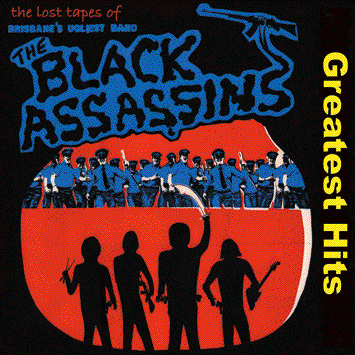
2. Stephen Stockwell's band is called the Black Assassins and he plays the keyboard. A few songs include "Planet X", "Barricades" and "Death Take Me Now".
last stand-- found via Youtube, video of Black Assassins came up - clicked to their channel - clicked on the band webpage in their info. I then clicked "links" which lead to clicking a link called "Brisbands", clicked on "Band List" - clicked on "The Black Assassins" which revealed information of band members which included Stephen Stockwell - keyboard and vocals! http://members.optusnet.com.au/~toxicoh/blackas.htm 24th August 2011.

3. The Large Hadron Collider is the world's biggest machine (found typing "biggest" AND "machine" AND "the world" in the library catalogue which brought up this article: http://global.factiva.com.libraryproxy.griffith.edu.au/ha/default.aspx)  located beneath the French-Swiss border it has a circumference of 27km, cost 2.6 billion pounds and weighs 38,000 tonnes (found via yahoo typing "how much does the LHC weigh?" http://lhc.ac.uk/about-the-lhc/faqs.html) Found 26th August 2011.

4. Justin Beiber's lawyer is Kenneth Feinswog, found via search engine on the same website as this link http://www.aceshowbiz.com/news/view/w0006112.html Following this, I found the best way to contact him is on this number (310) 277-8211 found via yahoo search for his name: http://www.manta.com/c/mms3lh1/feinswog-kenneth-a Found 25th August 2011.

5. The cheapest transport from Gold Coast to Melbourne is via airfaresflights.com.au which offers deals on various airlines -- http://www.airfaresflights.com.au/flights/Melbourne/Gold_Coast-OOL/

6. Hatsune Miku is a Japanese anime character with a synthesised  voice made by Vocaloid. She is owned by Big Smile Company and her birthday is August 31st.

--found via Youtube by typing "Hatsune Miku" http://www.youtube.com/watch?v=kbbA9BhCTko and "Hatsune Miku birthday" http://www.youtube.com/watch?v=B6_T8rxzeMM 24th August 2011.

7. Webcams all over Belarus found here http://www.ostamyy.com/webcams-Belarus.htm by typing in "webcams in Minsk" on Ask.com.

You can stay in Antarctica on a cruise http://www.antarcticatravel.com/9503823_89299.htm. Found by typing "antarcticatravel.com". Or you can stay in the stations, and even tents: http://wiki.answers.com/Q/Where_do_tourists_stay_in_Antarctica found on answers.com -- 26th August 2011.

8. This was a hard question but I think it was "(Everything I do) I do it for you" by Bryan Adams found via ask.com http://mag.weddingcentral.com.au/music/songs/songs1991.htm

9. The Google Street View car is a Subaru Impreza. Found via answer.com typing in "Google street view car" and a picture with the car brand was on the this page http://www.answers.com/topic/google-street-view.

10. Translated via http://www.worldlingo.com/en/products_services/worldlingo_translator.html


1. ¿Dónde estaba la Universidad estableció por primera vez y en qué año?
2. ¿Qué es la banda de Stephen Stockwell se llama y qué hace el juego? ¿Puede usted nombrar un par de sus canciones?
3. ¿Cuál es el peso de la máquina más grande del mundo? ¿Cuánto costó a la estructura?
4. ¿Quién es abogado de Justin Bieber, y cuál es el mejor contacto de la manera (lo más aprisa posible, el más confiable) el abogado?
5. ¿Cuál es la forma más barata de recorrido de la costa del oro a Melbourne?
6. ¿Quién es Hatsune Miku? ¿Qué compañía ella pertenece? ¿Cuál es su cumpleaños?
7. Encuentre un webcam vivo en Belarus. Encuentre un lugar para permanecer en el antártida.
8. ¿Qué canción era la tapa de las cartas australianas del estallido esta semana en 1991?
9. ¿Qué tipo de coche se utiliza para hacer la opinión de la calle de Google del `'?
10. Traduzca estas preguntas a español y después tradúzcalo nuevamente dentro de inglés.


Translated back with the same site http://www.worldlingo.com/en/products_services/worldlingo_translator.html


1. Where was the University established for the first time and in what year?
2. What is the band of Stephen Stockwell is called and what it matches?  Can you name a pair of your songs?
3. Which is the weight of the greatest machine of the world?  How much cost to the structure?
4. Who is lawyer of Justin Bieber, and which is the best contact of the way (possible, more fast most reliable) the lawyer?
5.  Which is the cheapest form of route of the coast of gold to Melbourne?
6.  Who is Hatsune Miku?  What company she belongs?  Which is its birthday?
7. Find webcam alive in Belarus. Find a place to remain in the antártida one.
8. What song was the cover of Australian letters of the outbreak this week in 1991?
9. What type of car is used to make the opinion of the street of Google of “”?
10. Translate these questions to Spanish later and tradúzcalo again within English.

LOL.


Week 5 - Response to Content


Having studied Screen Analysis in semester 1 I found this lecture to go over a lot of familiar content, but the 3 Act Structure paradigm was new, and useful! Every movie I watch I now look for the two pivotal plot points! Although the topic 'Classical Hollywood Cinema' I covered, it seems it wasn't in this much detail.


In classical Hollywood cinema we often find two narrative lines of action, which interconnect by the film moving back and forth between them. You will often notice the secondary line, compared to the 'main line', is a romance between the protagonist and a character they meet within the constraints of the diegesis, meaning the story world (Thompson & Bordwell  2010, p.80). This is not always the case, but it is often enough to make mention of.


The protagonist will often dominate the narrative action, and be involved in both lines of action. Scenes in classical narrative will connect with the use of a "dangling clause" which involves the deliberate construction of a scene to leave issues unresolved at the end to be picked up later (Moran 2011). Other methods of connecting scenes involves the repetition of dialogue or significant objects. And an editing convention much used is the 'montage' in where a series of quick shots are spliced together to give the impression of time passing whilst the character is trying to achieve something, or perhaps travelling somewhere. All these conventions and an abundance of others are utilised in the classical Hollywood narrative.

Bibliography
-- Bordwell, D & Thompson, K 2010, Film Art: An Introduction, McGraw-Will, New York

-- Moran, A 2011, Introduction to Screen Analysis 1009HUM Week 7 Lecture: Classical Hollywood Narrative: Features, retrieved from Griffith University, School of Humanities, Learning @Griffith website: <https://learning.secure.griffith.edu.au/webapps/portal/frameset.jsp?tab=courses&url=/bin/common/course.pl?course_id=_93829_1&frame=top>

Week 4 - Tutorial Task

Post 1:
What sort of computer games do you find most engaging? Why? What does it say about you? Why does computer game violence, mostly, not affect the players? Is there a level at which it does effect changes in people?
I'm a RPG, or "Role Playing Game", girl through and through. Baldurs Gate 2 and Dragon Age come to mind. These are fantasy type RPGs which all have the origin of Dungeons and Dragons. I think this reflects my love of journeys, of the long route to the goal. In these games you interact with hundreds of characters throughout to try and figure out where to go next, get quests and open up alternative story lines. It's mainly about the story, which has as much thought put into it as the game play. 


Personally I have never treated video and computer game violence with as much gravity as concerned adults have since they emerged. I think the violence doesn't affect players in general because of the fantasy quality, most games make the violence so far from realistic that you don't link it to reality at all, or they make it comical and thus detract from the seriousness. Although I can see why people are concerned, I treat it as I would any medium that contains violence - if you're so worried, then don't allow your children to watch/play the show or game. 


I found a journal article from a few years back where psychologists at St. Leo University in the U.S found after 20 years of studies that violent games can trigger hostile behaviour in kids (Harrar 2006, p. 46). Which makes  fears even more justified. Another article (Hoerrner M & K 2006 p. 12) quotes a consultant named Lt. Cl. Dave Grossman who wrote a book "Stop Teaching our Kids to Kill". Grossman believes first person shooters are like military instructional videos to improve a soldiers shooting precision. A horrible example of this communicating to real life is when a 14-yr-old boy open fired on a church prayer group in Paducah, Kentucky, US and landed eight out of eight shots, fired at eight different people. Most of them were head shots. He had never used a gun before, but the weapon he used was the same as the one used in the game.


This evidence is shocking to say the least, but I must point out in the second example that America has gun laws which make acquiring a gun easy and quick, bullets are available in Wall-Mart! I think if you looked up cases of teen violence caused by video games in Australia, you would find few, if any. In relation to the last question, at what level does it effect a change? - I think this is hard to pin down. It is always dependent on the individual. A teen might already display aggressive tendencies, and these games encourage them to act out these tendencies. It might be that if played from a very young age, with no adult pointing out the difference between the virtual reality and the physical reality, a young mind might think it logical to act this way, and commit acts of violence outside the game.


It's a contentious topic to say the least, and to be conclusive would require hours and hours of research and case study comparison. 


Bibliography
Harrar, S 2006, 'Video Game Violence', Prevention, vol. 58, no. 2, p.46, viewed 27th August 2011 via ProQuest Central


Hoerrner, M Hoerrner, K 2006, 'Video Game Violence', Prevention, vol. 15 no. 1, pp.12-14, viewed 27th August 2011 via ProQuest Central.

Post 2:
In early 2009 Facebook revised their terms of service which caused a major backlash from users. Originally in the terms a clause states that once your account is deactivated you can still delete files and photos you uploaded.  On February 4th this clause disappeared, causing major concern that Facebook could "retain control of user's data in perpetuity" (Greek 2009) and thus use this data in marketing and advertising.

Mark Zuckerburg was forced to backtrack, and when you view the 2nd point in the Terms page today is states that their "IP license ends when you delete your IP content or your account, unless your content has been shared with others, and they have not deleted it." (Facebook 2010) The types of content allowed on FB is virtually endless, except of course anything that infringes on copyright or intellectual property laws, and violates another person's rights. In the 3rd point under Safety it claims "You will not collect users' content or information, or otherwise access Facebook, using automated means (such as harvesting bots, robots, spiders, or scrapers) without our permission." I want to point out the without our permission part, which pretty much states that our information can be 'harvested' if given the go ahead? Are marketing companies doing this for a large whack of money?

In terms of content, they claim at the very beginning that we own all of our content and information posted on Facebook, but in terms of photos and videos, I think this clause sums it up:  "[...]you grant us a non-exclusive, transferable, sub-licensable, royalty-free, worldwide license to use any IP content that you post on or in connection with Facebook (IP License). " (Facebook 2010). They own your photos and videos as long as you're account is activated.

Guarantees of privacy are all up to the user. There are options to keep your profile private or public (even to the point where it's "Friends" or "Friends of Friends"), and if you don't want the metadata of your photos stored, then you have to remove it. You can alter who sees what in the Privacy Settings in your 'Account' tab.

Bibliography
Greek, D 2009, 'Facebook terms under scrutiny', Computer Act!ve, March 5th, viewed 27th August 2010 via ProQuest Central.

Week 4 - Response to Content

Is cyberspace the new heaven? The idea of achieving some form of immortality via the upload of personal data and the interactions within cyberspace, bring to light speculation that we have a dual split between mind and body. But just as Stephen's  lecture discusses, it is our body that is immortalised, rather than the mind/soul. This reversal is in direct opposition to Descartes dualism expounded in the 17th century (Custance 1997, Ch. 2). Perhaps it's not a 'heaven', an escapism, but a form of reality. My previous post discussed Gibson's rhetoric that Google is now making cyberspace physical. "Physical" connotes reality, as we believe that the physical is a way of determining what is real and thus separate it from the virtual or fantastical.

This polarity, this distinction, is now blurred. The sensations, the emotions and the connections created and felt within this virtual space, called 'cyberspace', are physically manifested in our selves. Our body reacts through an interaction with our mind, which is consumed within this hyper-reality.  And so our bodies become timeless. Who's to say this isn't real? I am playing with other physical beings, reading information and traversing forums created by other real people, so the world between worlds must be certain, actual. Plato believed the world we perceive is merely a poor copy of reality (the shadows on the wall in "the allegory of the cave") (Kreis 2000, lecture 2), and the only way to perceive the 'real' was to be shown the light by the truly wise. I'm assuming the reality we perceive currently is dominated by media and technology, and if Plato were around today he would remove us from illusion and show us the light of reason and rationality.

This rationalism is now in question. There are no despotic stories ruling the power/knowledge relationship when the screen allows the multiplicity of tales, and the embracing of difference.


Bibliography
Custance, A 1997, The Mysterious Matter of Mind, viewed 26th August 2011 <http://custance.org/old/mind/ch2m.html>


Kries, S 2000, Plato, Allegory of the Cave, viewed 20th August 2011
McNett, G 1999, Is internet the new Heaven?, viewed 26th August 2011 <http://www.salon.com/tech/books/1999/07/15/cyberspace/index.html>


Week 3 - Tutorial Task

1. Stephen Stockwell's first academic article to be published was in the Legal Service Bulletin under the title of 'Kuranda police shooting'.

- Stockwell, S 1981, 'Kuranda police shooting', Legal Service Bulletin, vol. 6, pp.48-49, viewed 10th August 2011 via HeinOnline.

2. The character Govenor Slugwell was introduced through the Flaming Carrot Comics. He made an appearance in issues 7, 10 and 11.

- Burden, B 1985, 'When the shoes aren't worth the shine', Renegade press, no. 7, p.p. 3 - 31. Viewed 11th August 2011 via. Trial Database undergound and independent comics.

3. The news article I found displaying the latest medical thinking was from The Sunday Telegraph in London on 15th May 2011. 'Experts' in Europe say that wifi and mobile phones are putting pupils at risk due to the recently raised concerns that electromagnetic radiation emitted by devices can be carcinogenic.

- Gray, R 2011, 'Pupils at risk from wi-fi and mobile phones: European experts say that devices should be banned from schools. Report also highlights concerns about safety of baby monitors. Call for ban on wi-fi in schools',  The Sunday Telegraph [London, UK], p.1, viewed 12th August 2011 via ProQuest.

4. In the 1982 draft script of Bladerunner Leons reaction is:
"Leon looks shocked, surprised. but the needles in the computer barely move. Holden goes for the inside of his coat. But big Leon is faster. His laser burns a hole the size of a nickel through Holden's stomach. Unlike a bullet, a laser causes no impact. It goes through Holden's shoulder and comes out of his back, clean as a whistle. Like a rag doll he falls back nto the seat. Big slow Leon is already walkng away, but he stops, turns, and with a little smile of satisfaction fires through the back of the seat."

- Hampton, F. Webb, D. Roland, K 1982, 'Blade Runner', (script), Warner Brothers, Los Angeles, CA. Viewed 11th August 2011, via. Trial database American film scripts online.

5. Soukup states that Ong says. "a society that is given so much to the use of diagrams and to the manoeuvring of objects in space... should at the same time develop means of communication which specialise not in sight but in sound" 


- Soukup, P 2004, ‘Communication Research trends’, Centre for the Study of Communication and Culture, vol. 23, pp. 23.


Part 2:

IRC, or Internet Relay Chat, is a software which provides the means for one person to type a message in real time to one or more other internet users, and almost instantaneously, it materialises on all the monitors of those plugged into the same transmission.

But how did someone use it? Well, most obviously, one needed an internet connection. Coupled with this, an IRC user would have access to a "software package that allows users to connect to the IRC server's special computers reserved for interactive conversations." (Simpson 2000, p.18). There were various packages available, with the most popular on PC's being mIRC, a shareware that puts IRC servers and advanced IRC features only a click away. It was first created by Jarrkko Oikarinen in 1988 when he was asked to replace a program called MUT (MultiUser Talk) on a BBS (bulletin board system) called OuluBox. Inspired by Bitnet Relay Chat he created IRC in August of that year, date unspecified (Oikarinen 2005, p.1). As is developed  it not only allowed people to create  or join multi user conversations, but also private ones, enabling you to interchange between more than one at a time.

This system in it's heyday was popular with educators, experts and people wishing to collaborate on a myriad of subjects over long distance. Educators particularly found it useful for interacting with students, and for students to link up to discuss and work on projects. As it became more popular, multi person chat rooms such as this made way for fantasy world games to spark up, with textual ways to communicate physical realities increasing (Reid 1999, p.399). Various splits were made from IRC, causing disagreements among the main managers and eventually it was left behind amongst the explosion of internet chat forums, especially MSN. Their peak was at 100,000 users.

Bibliography